


SUMMARY
In many sectors-from utilities to industry, from property management to technical infrastructure management-the ability to handle an urgent request in a timely and accurate manner is an essential element in ensuring business continuity, security and customer confidence.
Technical failures, emergency alerts, plant or infrastructure interventions, are situations in which every minute counts and in which the request management system must operate 24/7, 365 days a year.
However, many companies still rely on traditional on-call models based on switchboards or manual escalation management systems. Structures that, over time, have shown obvious limitations: difficulties in handling peak requests, margins for error in managing engagements, and high costs to ensure continuous service coverage.
In this scenario, the evolution of Artificial Intelligence is opening up new possibilities.
Emergency management
When there is a technical problem or urgent report, the request management system should activate immediately.
An effective process must ensure:
- immediate reception, with no waiting time;
- certain identification of the caller;
- accurate collection of reporting information ;
- correct activation of the on-call technician or team;
- full traceability of theintervention.
In traditional models, these activities depend almost exclusively on manual handling by operators. This approach may work under normal conditions, but it becomes fragile when the volume of requests increases or when escalation procedures are complex.
It is precisely in these contexts that intelligent automation can make a difference.
From traditional automation to Agentic AI
In recent years, Artificial Intelligence has evolved rapidly from simple automated response systems to more advanced solutions based on Agentic AI.
AI agents are intelligent systems capable not only of dialoguing with the user, but also of understanding context, accessing business data and triggering operational actions.
Unlike traditional chatbots, a virtual agent can:
- automatically recognize the caller;
- verify information in business systems;
- collecting data from a report;
- assess the level of criticality of the request;
- activate predefined escalation procedures.
This shift marks a major shift from simple automated response to intelligent management of operational flows.
The INGO model: technology, platforms and operational skills
INGO positions itself as a knowledge company specializing in the design and management of advanced Customer Operations.
The value of INGO comes from the integration of four key elements:
- advanced technology platforms;
- artificial intelligence solutions;
- process automation;
- specialized operational skills.
This approach enables companies to transform the management of even the most critical requests into structured, scalable, data-driven processes.
INGO designs service models that integrate AI, processes and people, adapting them to the specific needs of each sector.
Automated on-call service: intelligent engagement management
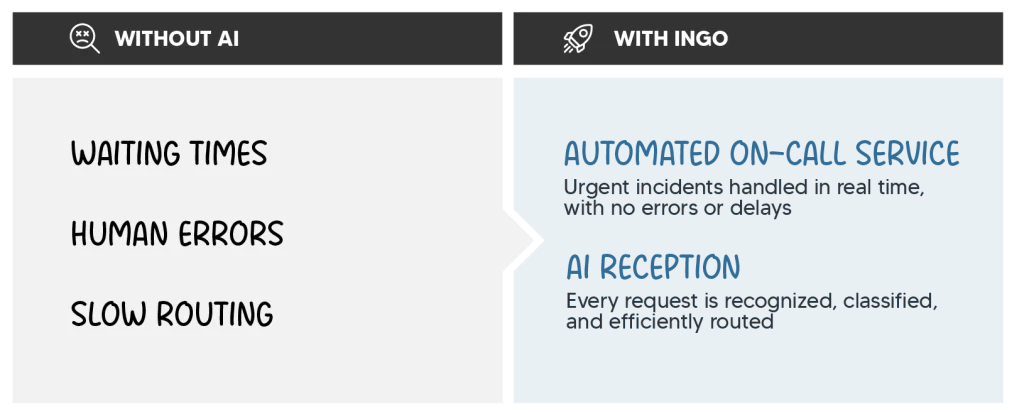
Among the solutions developed by INGO for managing critical services is Automated on-call service, designed for companies that need to handle technical interventions or urgent reports.
Through integration between AI platforms and business systems, the system is able to:
- automatically identify the caller;
- collect essential information about the report;
- apply the escalation procedures defined by the company;
- immediately activate the correct on-call technician.
The process takes place without waiting time and with complete traceability of operations.
This model reduces the risk of human error and ensures precise management of engagements even in high-pressure situations.
AI Reception: intelligent reception and multichannel management
Alongside emergency management, INGO also develops AI Reception solutions designed to automate and optimize the handling of incoming requests.
The system combines intelligent virtual agents with human supervision and enables:
- manage telephone reception automatically and multilingually;
- recognize the origin of calls;
- classify requests according to type;
- directing interactions to the appropriate departments.
This model enables companies to efficiently handle both routine and more complex requests while maintaining a high quality of service at all times.
The results
The adoption of AI and automation-based models brings tangible benefits both operationally and on the customer experience.
Among the main advantages:
- reducing operating costs by automating repetitive processes;
- autonomous handling of a significant proportion of calls;
- greater precision in escalation management;
- ability to handle variable volumes without increasing resources.
In many cases, up to 80 percent of first-level requests can be handled automatically, leaving the more complex situations to be handled by specialized operators.
The future of critical services between human & AI
At INGO, we believe that the most effective innovation comes from theintegration of technology and human skills.
Automating emergency management does not mean eliminating the role of people, but allowing them to focus on activities where experience and decision-making skills really make a difference.
Artificial Intelligence manages the timeliness and accuracy of processes, while people provide analysis, supervision and management of the most complex situations.
It is this integration of platforms, AI, automation, and operational expertise that enables companies to manage critical services more efficiently, reliably, and scalably.
And it is in this integration that INGO‘s role lies: to transform technology, data and operational experience into concrete models of evolved Customer Operations.
Uninterrupted availability
Ensure continuity for your customers
Learn how to implement intelligent emergency management systems to ensure your customers always receive reliable service.
GET MORE INFORMATION
Contact us
Find out more about our CX services
INGO, thanks to multichannel and technological innovations, is able to build specific projects for each company, following the process from the initial analysis phase to the implementation of integrated, scalable and modular omnichannel strategies. For over 20 years, Made in Italy at the service of the customer experience.
blog
Read more blog articles

E-commerce: CX strategies to be ready for the age of Agentic Commerce
Handling urgent requests and emergencies with traditional on-call models based on physical switchboards or manual procedures can generate delays, errors,…
Read more
Customer Experience in healthcare: data, AI, and automation for an effective Patient Journey
The customer experience in the healthcare sector requires understanding, anticipating, and improving every stage of the patient journey through the…
Read more
How to combine operators and automation for efficient and reliable service in the Utilities market
Customer Experience in the industry in 2026 requires understanding, anticipating, and improving every step of the way using integrated data,…
Read more